
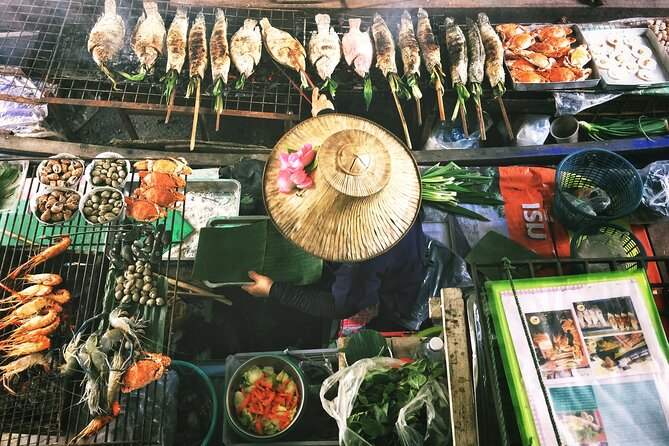
Reviewed · WALKING TOURS
Bangkok: Chinatown By Night Walking Tour
Bangkok’s Chinatown is at its best after sunset, when neon signs glow over Yaowarat Road and food stalls fill the lanes with smoke, spice, and chatter. This two-hour walk links that lively street scene with quieter places, including an old mosque, Chinese shrines, historic homes, and a community museum.
I like the local guides, who bring different strengths to the walk. Nam is especially engaging, while Tony took care to slow down for a tired child, and Dan pointed out small signs and side streets that are easy to miss. I also like the mix of street food and history, rather than a walk that treats Chinatown as one long row of restaurants.
The main drawback is pace. With about seven stops, food opportunities, and a return to the meeting point in roughly two hours, some visits may be brief. Chinatown is also crowded, and food is not clearly listed among the official inclusions, so bring cash if you want to sample more than the guide points out.
Key points to know before you go
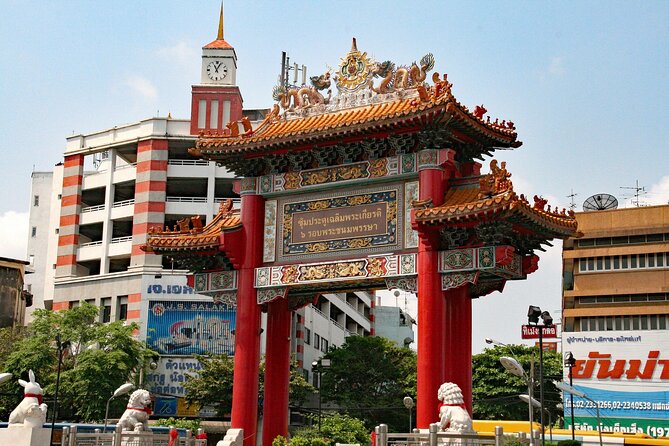
- Chinatown after dark: The 6:30 pm start puts you among Yaowarat’s lights, food stalls, and evening crowds.
- More than street food: The route includes a community museum, old market, mosque, temples, shrines, and Chinese courtyard homes.
- Guides make the difference: Nam, Jimmy, Tony, Bass, Dan, and others have been praised for warm storytelling and practical help.
- A low-cost introduction: At $15 per person, the walk gives you a useful orientation without a large financial commitment.
- Food costs extra unless confirmed: You may see and taste popular dishes, but entry fees and personal purchases are not included.
- Expect a group setting: The maximum group size is 99 people, so this may feel like a large walking tour rather than a private stroll.
Why Chinatown works better at night
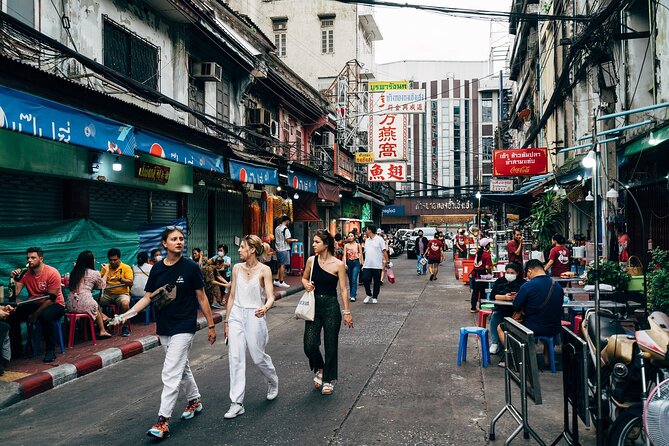
Bangkok’s Chinese quarter has two faces. By day, it is a working district of gold shops, herbal medicine stores, wholesale goods, shrines, and old family businesses. After dark, Yaowarat Road becomes a glowing corridor of signs and food stalls, while the side lanes retain a more local, lived-in feel.
That contrast is the chief reason to take this walk instead of simply wandering along the main road. Your guide helps connect the gold trade, Chinese-Thai culture, religious sites, and food traditions. You still get time to look around, but you are less likely to walk past a small shrine or old building without understanding why it matters.
The meeting point is at Hua Lamphong, near Rong Muang in Pathum Wan, with the start set for 6:30 pm. The tour returns to that same meeting point. Since the route uses public streets and is near public transportation, it fits well on an evening when you want a structured introduction before exploring on your own.
More Walking Tours in Bangkok
- Bangkok: City Highlights Temple and Market Walking Tour
★ 4.5 · 3,990 reviews - Bangkok: Grand Palace and Wat Phra Kaew Guided Walking Tour
★ 4.4 · 2,417 reviews - Bangkok: Wat Pho and Wat Arun Guided Walking Tour
★ 4.6 · 1,720 reviews
Chareon Chai Community Museum and old neighborhood life
One early stop is an old house converted into a community museum. Its purpose is to preserve the history, culture, and daily life of the Chareon Chai Community.
This is the sort of place I value on a walking tour because it gives you a human scale. Chinatown can look like a collection of signs, traffic, and food counters when you first arrive. An old home used as a museum helps you see the district as a neighborhood where families worked, worshiped, traded, and adapted over time.
The stop may not feel as grand as a major Bangkok monument, and the tour does not include attraction admission. Still, it adds context that you will not get from a quick food crawl. If you care about how old districts survive beside newer shops and restaurants, pay close attention here.
A European-style mosque in a Chinese quarter
The route also visits an old mosque built in the unusual form of a European villa. That architectural detail alone makes it worth looking up from the food stalls.
Bangkok’s Chinatown is not a single-culture display. Chinese, Thai, Muslim, Buddhist, and other traditions have shared space here, and this mosque offers a clear reminder of that layered past. Your guide can explain the setting and help you understand why an Islamic building with a villa-like appearance belongs in this part of the city.
This is also a good example of why comfortable shoes matter. The appeal comes from moving between small, unexpected sites rather than spending the whole evening at one attraction. Keep your phone ready for photographs, but listen first, since the story is the reason the stop is included.
Talat Kao, Chinatown’s old market
Talat Kao, known as Chinatown’s Old Market, occupies a long, narrow alley off Yaowarat Road. It is a more enclosed and intimate setting than the main avenue, with traditional shopfronts and the close quarters that make old markets feel active and slightly chaotic.
The alley is useful for understanding how commerce shaped the district. You are not only seeing food stalls. You are moving through a working market where the width of the passage, the shop layout, and the goods on display all reflect years of trade.
This stop may be challenging if you dislike crowds or need plenty of personal space. The route passes through busy public areas, and the guide may need to pause often to keep the group together. That is normal for Chinatown, but it means the walk is not a quiet architectural tour.
Same base, a completely different sort of day out:
- Bangkok: Damnoen Saduak Market and Maeklong Railway Market
★ 4.5 · 26,723 reviews - The Old Siam: Damnoen Saduak and Maeklong Railway Market
★ 4.5 · 10,992 reviews - Bangkok: Train Market & Floating Market with Boat Ride
★ 4.7 · 9,547 reviews - Bangkok Canal Tour: 2-Hour Longtail Boat Ride
★ 4.5 · 5,909 reviews
Riverside temples and Bangkok’s old religious quarters
The walk includes a small temple close to the Marine Department station on the Chao Phraya orange express line. It can be seen from the riverside, which gives the stop a useful connection to Bangkok’s waterways and transport network.
Another stop is an old royal monastery established during the Ayutthaya era. That places the tour’s Chinatown story within a much older Bangkok setting. The Chinese quarter did not develop in isolation. It sits near the river, old transport routes, royal institutions, markets, and religious communities.
The supplied details do not specify the names of these two sites, so you should not book expecting a full guided visit inside every temple. The value is the explanation of what you are seeing and how the sites fit into the city. Entry fees are not included, and the route may focus on exterior views if time is short.
So Heng Tai Mansion in Talat Noi
So Heng Tai Mansion is a nineteenth-century Chinese courtyard house in Talat Noi, one of the most distinctive architectural stops on the route. Courtyard homes reveal a different side of Chinese Bangkok from the shop-lined streets. They show how a prominent family might have lived and organized private space around an internal court.
For me, this is one of the route’s most useful stops because it shifts the focus from food and commerce to domestic life. You get a glimpse of the older Chinese presence in Bangkok through a building rather than a restaurant menu.
Do not assume that every stop offers a long interior visit. The experience lasts about two hours, and attraction admission is excluded. Ask your guide what access is available on the evening you visit. If the mansion is viewed mainly from outside, the guide’s explanation becomes especially important.
Zhou Si Kong Shrine and Chinese traditions
The Zhou Si Kong Shrine is an old riverside shrine in Talat Noi, with roughly 200 years of history. It is associated with prayers for good luck, health, strength, and freedom from illness throughout the year.
This stop gives you a chance to see how religious practice remains part of ordinary neighborhood life. It is not simply an old building to photograph. People visit shrines with practical hopes and personal concerns, and your guide can explain the role of such places in Chinese-Thai culture.
Approach respectfully. Keep your voice low, follow any posted rules, and ask before photographing people at worship. A short stop can still be meaningful if you watch how the space is used rather than treating it as a quick photo backdrop.
Street food, herbal drinks, and what you actually pay for
Food is woven into the walk. Guides have taken participants to several stalls, explained popular Thai dishes, introduced Chinese cuisine, and pointed out traditional Chinese herbal drinks. Jimmy was singled out for explaining the food, while Dan showed delicious herbal drinks and offered useful suggestions for what to try.
The practical catch is that food is not listed among the official inclusions. Some experiences may include a small tasting, or the guide may direct you to stalls where you can buy food, but you should budget for your own purchases. The exact arrangement is not clear enough to assume a free meal.
That uncertainty is easy to manage. Carry cash, arrive hungry but not starving, and tell the guide about allergies or foods you cannot eat. The walk is better understood as a guided introduction to Chinatown’s food scene, not a fixed tasting menu.
You might see dishes that are unfamiliar, strongly seasoned, or served in small street-stall portions. That is part of the point, but you remain in control of what you buy. If food is your main reason for booking, confirm the tasting details before paying.
The guides and the feel of the group
The guide is central to this experience. Names associated with recent departures include Nam, Jimmy, Tony, Bass, Dan, Bobby, and Kim. The strongest descriptions emphasize warmth, cultural explanation, care with the group, and the ability to make history feel connected to the street in front of you.
Tony helped a young participant who was struggling with the heat, which is a useful reminder that Bangkok evenings can still feel demanding. Bass was praised for making a solo participant feel safe and well guided. Dan was noted for taking people into smaller streets and drawing attention to signs that could easily be overlooked.
The group limit is up to 99 people. That is a sizeable maximum, though the actual departure may be smaller. A large group can make narrow lanes slower and can reduce the chance for one-on-one questions. On the other hand, a guide who is clear and attentive can still make the evening work well.
Bring water, wear shoes suited to uneven pavement, and keep your belongings secure in crowded areas. The tour is only about two hours, but the heat, traffic, and tight streets can make it feel more active than the short duration suggests.
Is $15 good value?
At $15 per person, this is a modest price for a guided introduction to one of Bangkok’s most interesting districts. You are paying for local interpretation, route planning, storytelling, and a set of stops that would be easy to miss on a first visit.
The value is strongest if you want orientation. After the walk, you can return to Yaowarat Road, Talat Noi, or the food stalls with a better sense of what you are seeing. The price is less compelling if you expect a private guide, long interior visits, a full dinner, or extensive time at each monument.
Three self-guided tours in the Vox City app are included as an extra. That adds flexibility, especially if you want to continue exploring on your own, but the listing does not specify their subjects or length. Headphones are not included, and entry to attractions is separate.
Free cancellation is available if you cancel at least 24 hours before the 6:30 pm start. Changes or cancellations inside that window do not qualify for a refund, so check your plans before the deadline.
Who should book this Chinatown walk?
I would recommend it to first-time visitors who want a friendly introduction to Chinatown without committing to a costly food tour. It also suits families with older children, couples, and solo visitors who prefer having a local guide in crowded streets.
It is a good choice if you care about architecture, Chinese-Thai culture, temples, market life, and food. You do not need to choose between a history walk and a food walk here, though neither side receives the depth of a specialist tour.
You may want another option if you dislike crowds, need a slow pace, want a private experience, or expect all food to be included. The 99-person maximum is worth noting, and the two-hour schedule may feel tight if you like lingering at each site.
Final verdict: a useful first look at Bangkok’s Chinatown
Book this walk if you want to see Chinatown with more purpose than a solo stroll along Yaowarat Road. The combination of Talat Kao, the Chareon Chai museum, the unusual mosque, old Chinese homes, riverside shrines, temples, and street food gives you a broad introduction for a fair price.
Go in with realistic expectations. This is a compact public-street walk, not a private deep-history tour or a guaranteed dinner. Bring money for food, expect crowds, and let the guide’s stories connect the places. If that sounds like your kind of evening, $15 buys a useful start to exploring Chinatown on your own.
FAQ
Where does the Bangkok Chinatown night tour start?
It starts at Hua Lamphong, Rong Muang, Pathum Wan, Bangkok 10330, Thailand.
What time does the tour begin?
The scheduled start time is 6:30 pm.
How long does the walking tour last?
The tour lasts approximately two hours.
Where does the tour end?
The activity ends back at the meeting point.
Is food included in the tour price?
Food is not listed among the official inclusions. The route offers opportunities to see and try street food, but you should plan to pay for personal food purchases.
Are attraction entry fees included?
No. Entry to attractions is not included.
Are headphones provided?
No. Headphones are not included.
Can I cancel for a full refund?
Yes, if you cancel at least 24 hours before the experience start time. Cancellations or changes made less than 24 hours before the start are not accepted for a refund.
More Evening Tours in Bangkok
- Bangkok by Night: Temples, Markets and Food Tuk-Tuk Tour
★ 5.0 · 3,752 reviews - Bangkok: Evening Tour with Wat Arun, Wat Pho & Tuk Tuk Ride
★ 4.6 · 701 reviews - Bangkok Tuk-Tuk Tour by Night with Chinatown Street Food Meal
★ 5.0 · 635 reviews - Bangkok by Night Food Tour with 10+ Tastings in Chinatown
★ 5.0 · 545 reviews
Just added around Bangkok
- Wonderful Pearl Dinner Cruise★ 3.5 · 27 reviews
- Yoga in the Park Thailand★ 5.0 · 12 reviews
- re:leaf spa and massage★ 4.0 · 10 reviews
- 3-Hour Bangkok Walking Tour: Wat Pho and Wat Arun★ 5.0 · 102 reviews
- White Orchid Sunset Dinner Cruise Calypso Ladyboy Cabaret Show★ 4.0 · 10 reviews
- Visit temples in and around Bangkok with a former monk of 10 years★ 5.0 · 30 reviews
- Morning Buddhist Almsgiving, Grand Palace and Flower Market Tour in Bangkok★ 3.5 · 9 reviews
- Visit Wat Pho and Wat Arun with Local Expert★ 4.0 · 14 reviews
Walking Tours, compared.
City Highlights Temple and Market Walking Tour
Read our review →
Grand Palace and Wat Phra Kaew Guided Walking Tour
Read our review →
3 Hour Old City and Temples Guided Walking Tour
Read our review →
Beach walk with elephants, rain & care. 2.5 hours
Read our review →
Bukit Elephant Park Sanctuary Walk and Feed Tour
Read our review →
Bangkok Authentic Tasting Thai-Chinatown Walking Food Tour
Read our review →
Browse the lists this tour appears in