
Reviewed · TEMPLE TOURS
Bangkok: Backstreets and Historic Temples Bike Tour
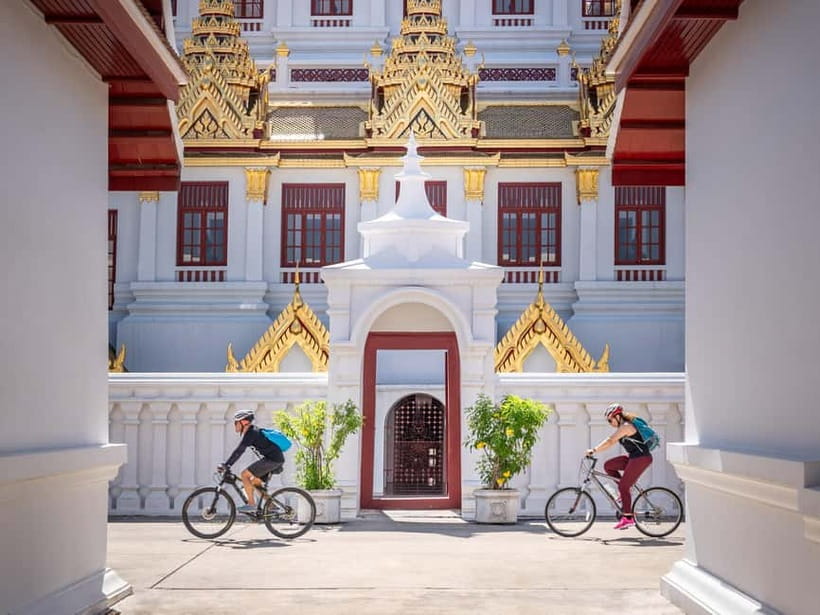
Bangkok reveals itself differently from a bicycle seat. This four-hour ride leaves the traffic-heavy roads behind and slips through narrow lanes, canal paths, food markets, temple grounds, and neighborhoods where people live and work. The Bangkok Noi canal route is the heart of the experience, with Muslim homes, Buddhist temples, an old train depot, and a possible stop at a bronze bowl workshop.
I like the quality mountain bikes and careful guides, especially when the route squeezes through tight alleys or crosses busy city roads. I also like the useful mix of temples and everyday scenes, from Buddhas being made near the Giant Swing to snacks bought at a local market. The drawback is that this is not a classic sightseeing tour. You will pass famous places, but the focus is street life, not long visits inside Bangkok’s headline temples.
Key things to know before you pedal away
- The route covers about 15 kilometers: The ride is mostly flat, but narrow lanes and city traffic call for steady bike handling.
- Bangkok Noi is the main attraction: Expect canals, homes, religious sites, and an old train depot rather than a string of major monuments.
- You cross the river twice: The Rama VIII Bridge takes you out toward Thonburi, and a local ferry brings you back.
- Food and drinks are included: Water, soft drinks, and snacks appear along the way, with a market stop if you need something more substantial.
- The tour starts early: Meet at 8:30 am for fitting and briefing, then depart at 9 am sharp.
- Dress matters: Comfortable shoes and sunscreen are useful, but shorts and sleeveless shirts are not allowed.
Why this bike tour shows you a different Bangkok
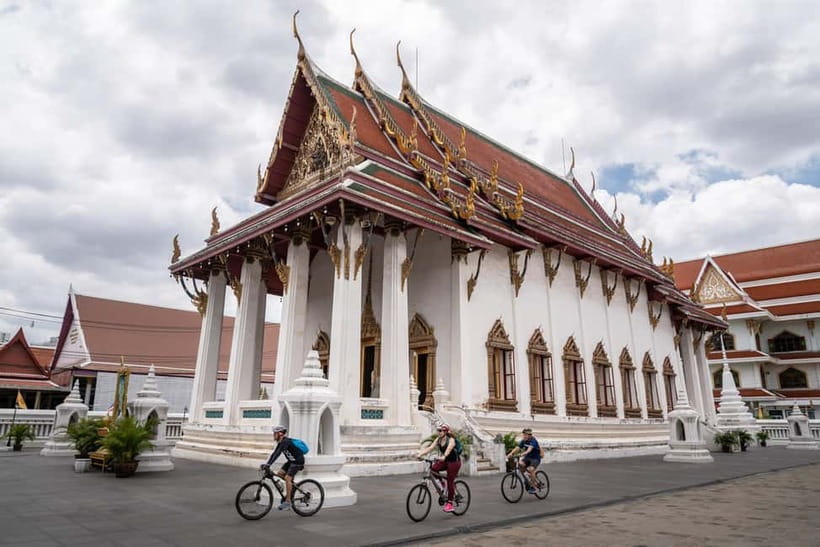
The best reason to book this ride is simple: it takes you into parts of Bangkok that are awkward to reach on foot and easy to miss from a taxi. You move through the city at street level, slowly enough to notice laundry hanging beside canals, small shrines, workshops, food stalls, and children’s play areas.
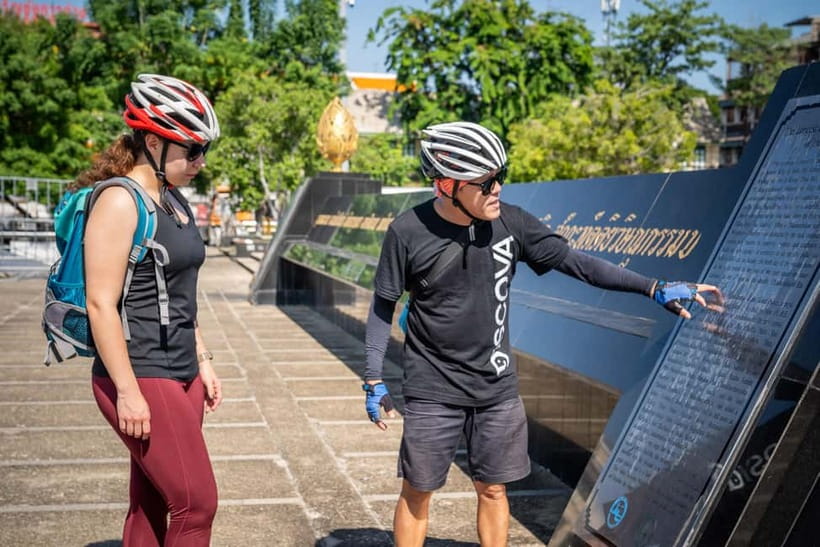
That slower pace also gives your guide room to explain how the city works. Guides such as Max, Bett, Seen, Woody, Kan, Tammy, and Tom have led this route, and the strongest part of the experience is the personal explanation along the way. Seen, in particular, has been praised for pairing a strong knowledge of Bangkok and its culture with good control of the group. Kan has also been noted for explaining Buddhist temples, paintings, and local food.
You should not expect a polished sightseeing circuit. Some lanes are gritty. Some roads are narrow. Traffic noise can make it hard to hear every comment while riding, especially if the guide gets a little ahead. Still, that rough edge is part of the point. You are seeing working neighborhoods, not a stage set made for visitors.
More Cycling Tours in Bangkok
- Bangkok: Temples, Canals & Local Life Bike Tour
★ 4.9 · 3,511 reviews - Experience Real Bangkok by Bike
★ 5.0 · 2,439 reviews - Bangkok: Bike and Canal Boat Tour with Lunch
★ 4.9 · 1,350 reviews
Meeting at 8:30 am near MRT Sam Yot
The tour begins at the Discova Day Tour Shop Bangkok, at 719 Mahachai Road in the Wang Burapha Phirom area. The shop is near MRT Sam Yot Station, on the next block from Miramar Hotel, in the last building beside the canal.
Arrive at 8:30 am. That gives the staff time to adjust your bike, provide a helmet, collect participant names for insurance, and check heights so each person receives a suitable bike. The group leaves at 9 am sharp, so arriving late is a poor gamble.
The supplied bikes are quality mountain bikes, and good equipment makes a real difference in Bangkok. You will be turning often, stopping at short notice, and riding over uneven surfaces. A helmet is included, as are drinks, water, and snacks.
Wear comfortable shoes and sunscreen. The dress code asks you to avoid shorts and sleeveless shirts, which is practical for temple areas as well as useful for sun protection. Pregnant women should not book this activity. Child seats can be requested, but they accommodate a child weighing up to 14 kilograms.
Khaosan Road gives way to quiet lanes
The opening section moves through the Khaosan Road area before the route turns away from the main roads. This is a useful change in mood. You begin in one of Bangkok’s best-known backpacker districts, then quickly see how different the city feels once the large streets fall behind.
The narrow lanes are not built for speed. You may need to brake often, steer around people, and keep close to the guide. A past rider found the road conditions challenging but also felt well protected because the guide stayed attentive and made sure the group was comfortable.
This is not a hard athletic ride in terms of hills. The route is generally flat, but bike control matters more than fitness. You should be comfortable starting and stopping, handling a narrow passage, and staying aware around traffic. Parents should also think carefully about how their children manage a bike in busy urban conditions.
Crossing the Rama VIII Bridge
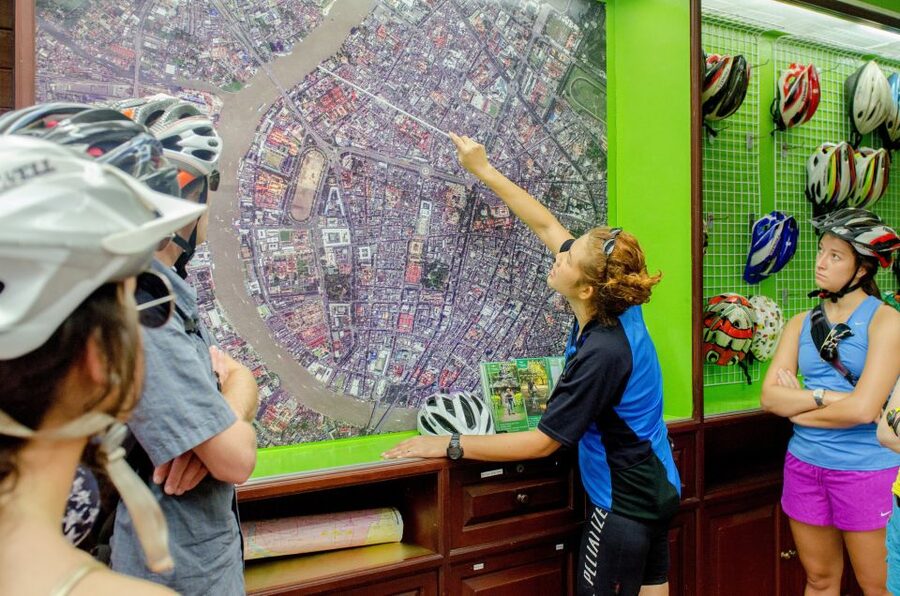
The route follows the Chao Phraya River before crossing the Rama VIII Bridge. The bridge section gives you a broad city view and a clear sense of Bangkok’s two-sided character. One side feels like the old central city, while the ride toward Thonburi leads into quieter canals and residential lanes.
The bridge is one of the few points where the tour feels like a conventional Bangkok view. Most of the route is close-up and intimate, so this higher crossing provides a welcome change. It also helps explain the geography of the ride: you are leaving the familiar central sights and heading into areas shaped by waterways rather than broad avenues.
Keep your expectations practical. This is a guided cycling stop, not a long photo session. If you want to take pictures, listen for the guide’s instructions about when it is safe to pause.
More Historical Tours in Bangkok
- Foodie Experience of Historic Bang Rak
★ 5.0 · 109 reviews - Bangkok: Backstreets and Temple Historic Bike Tour
★ 5.0 · 84 reviews - Bangkok Heritage Highlights: Grand Palace & Three Temples Tour
★ 4.5 · 52 reviews - Bangkok History Temples Markets and Food Tasting
★ 5.0 · 40 reviews
Bangkok Noi: canals, homes, and two sides of city life
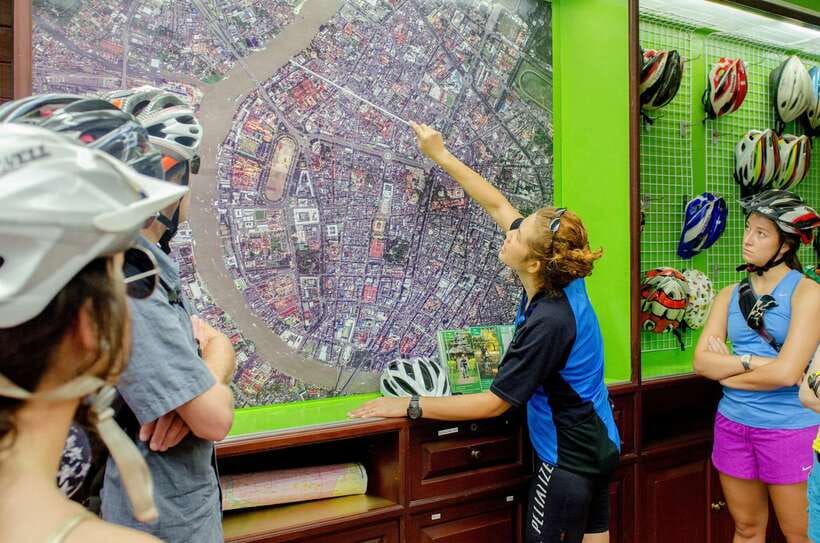
Bangkok Noi is a large canal connected to the Chao Phraya River, and it gives the tour its strongest sense of place. You pedal along tiny lanes beside the water, passing homes and community spaces that are easy to miss from a road vehicle.
One section takes you through a Muslim community. Later, after crossing a bridge, the route follows the canal in the other direction past Buddhist temples. That contrast is one of the tour’s best features. Within a fairly short distance, you see different religious communities and ways of life connected by the same waterways.
The canal route also explains why a bicycle works so well here. A bus or taxi cannot reach many of these lanes. Walking would be possible in places, but the distance and number of turns would make it difficult to cover the same ground in a morning. On a bike, you can move between communities without losing the sense of being close to the street.
You may find some surfaces uneven, and the route can feel cramped at times. That is not a ride for anyone who wants a wide, predictable cycle path. It is a close-quarters city ride, and you should stay behind the guide when the passage narrows.
Baan Bu and the old train depot
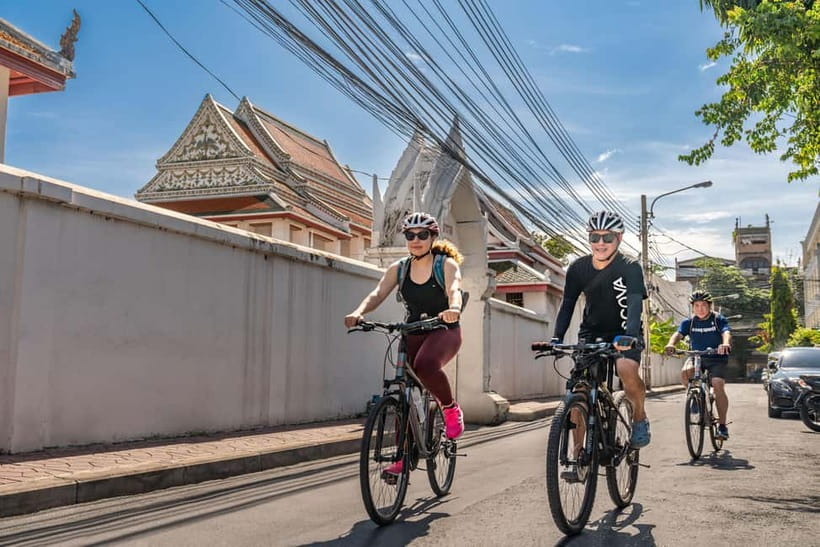
The Baan Bu bronze-working community adds a craft element to the morning. If the workshop is open, you may see a bronze bowl foundry and gain a better idea of how traditional work fits into modern Bangkok. This is a more unusual stop than a standard temple visit, and it gives the ride a useful connection to local making and trade.
The old Thonburi train depot adds another layer. If access is available, you may see old steam engines and the remains of one of Bangkok’s first train depots. The stop is not guaranteed, so treat it as a welcome possibility rather than the main reason to book.
These visits also show why the tour can vary slightly from one day to the next. Small workshops and community spaces do not operate like fixed museum exhibits. The guide has to work with what is open and accessible, which can make the morning feel more local but less predictable.
A local ferry brings you back across the Chao Phraya
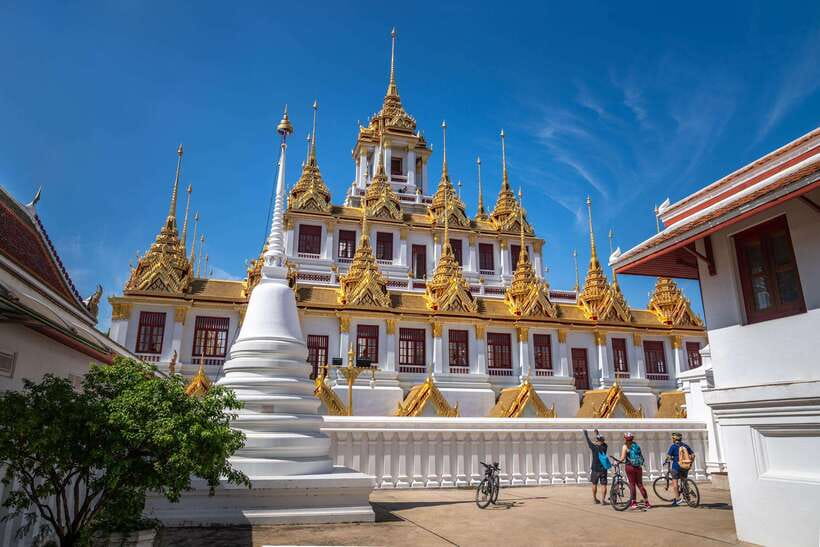
After the Bangkok Noi section, you take a local ferry across the river. The ferry is included in the route and breaks up the cycling with a short water crossing. It also gives you another angle on Bangkok’s waterways, which are central to the city’s layout and daily movement.
This is a practical crossing rather than a sightseeing cruise. Do not expect a long-tail boat excursion with a narrated tour. The listed plan identifies a ferry crossing, while the experience also includes river sightseeing and a boat ride as part of the wider route.
The ferry is one reason this tour feels more varied than a simple neighborhood ride. You cycle through lanes, cross a major bridge, pass canals, and then return over the river by local transport. The changing modes help keep the four-hour schedule interesting.
The Grand Palace area without a palace visit
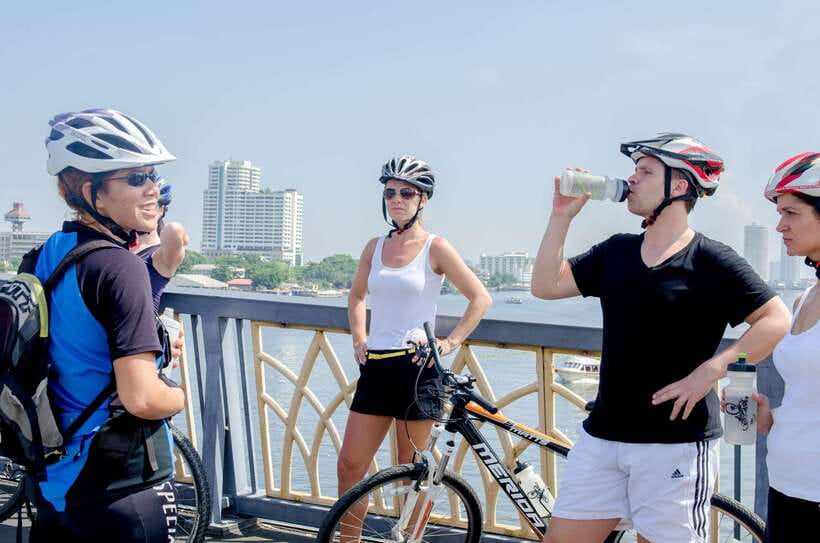
Back on the central side of the river, the route passes the Grand Palace. You do not spend the morning touring the palace interiors, so this should not replace a dedicated Grand Palace visit if that is a priority.
Instead, the guide takes you through a public park that was once used exclusively by the royal family. This is a quieter historical note, and it offers a different kind of connection to Bangkok’s royal past. You are seeing the setting from the outside and moving through it as part of a broader city route.
The distinction matters when deciding what to book. If you want detailed architecture, formal galleries, and extended temple visits, choose a traditional walking tour. If you want to connect the major central sights with the neighborhoods around them, this cycling route gives you more range.
Food markets, sacred images, and the Giant Swing
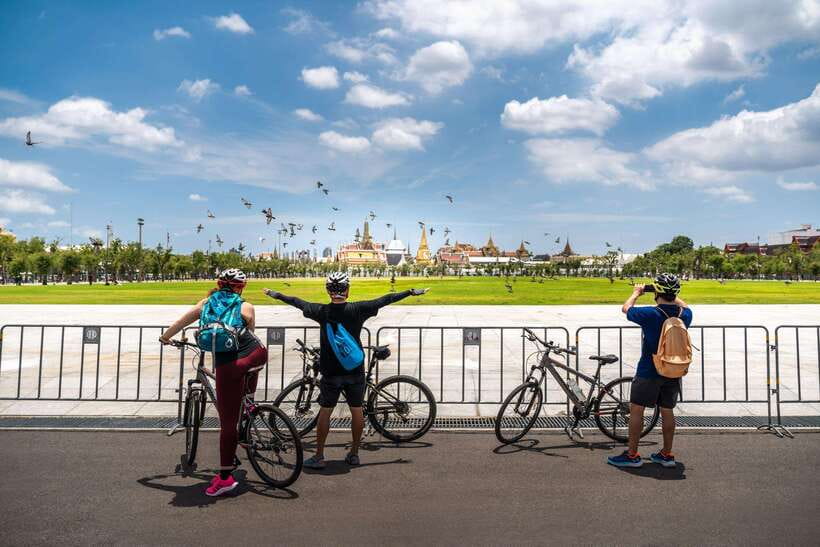
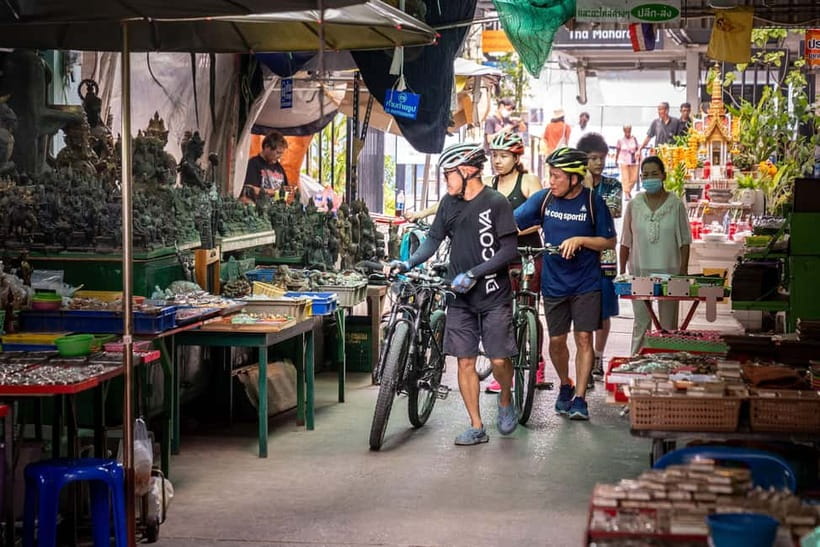
The final section returns to twisting lanes and passes through a food market. Snacks and drinks are included along the way, and the market is useful if you arrive without breakfast. One rider who had not eaten before the start was able to stop and buy food during the ride.
You may also pass rows of Buddha images and other sacred objects. The area around the Giant Swing is known for making and selling Buddha images, so this section shows both the religious and commercial sides of Buddhist culture. You are not just looking at finished objects inside a temple. You are seeing the surrounding trade that supports worship and decoration.
The Giant Swing itself is one of Bangkok’s landmarks. It was once used for an important Hindu ceremony, and it gives the final stretch a recognizable marker before you return to the bike shop. The stop is mainly a pass-by and sightseeing point, not a long formal visit.
The tour usually finishes around 1 pm, after about 15 kilometers. You should have time to eat lunch afterward and continue exploring the old city.
What the guides do well, and where the ride can falter
The guide is central to the quality of this experience. A good leader controls the pace, positions the group safely, and explains what you are seeing without turning every stop into a lecture.
The strongest guide feedback centers on friendliness, patience, route knowledge, and calm handling of small problems. One guide repaired a punctured tire without letting the delay spoil the mood, while another made sure a less experienced young rider received extra help. Several guides have also been praised for answering questions in detail.
There is one practical weakness: you may not hear every explanation while moving. Traffic, distance, and the lack of a microphone can make comments hard to catch. If a point interests you, ask the guide to repeat it when the group stops. Staying close is also wise, since the lanes can twist quickly.
Private and small-group options are available. A smaller group should make it easier to hear instructions and keep the pace comfortable, though the exact group size is not specified. If you value personal attention, ask about the group arrangement before booking.
Is $39 good value for four hours?
At $39 per person, the price is reasonable for a four-hour guided ride that includes a quality mountain bike, helmet, English-speaking guide, snacks, drinks, water, a ferry crossing, and access to parts of Bangkok that are difficult to organize independently.
The value is strongest if you want coverage rather than a single major monument. In one morning, you cross the Rama VIII Bridge, explore Bangkok Noi, pass temples and canals, visit a possible bronze workshop and old train depot, cross the river by ferry, pass the Grand Palace area, and finish near the Giant Swing.
The price is less compelling if you already have strong cycling skills, know the old city well, and mainly want temple interiors. In that case, you might prefer to spend $39 on individual admissions, food, or a shorter guided visit. You are paying here for the route design, bike, local navigation, safety support, and access to everyday areas.
Free cancellation up to 24 hours before the start and reserve-now-pay-later booking add flexibility. Still, provide full participant names, heights, and dietary requirements when booking so the operator can prepare the right bikes and refreshments.
Who should book this ride?
I would choose this tour if you want to see Bangkok beyond its major monuments and are comfortable riding in a busy Asian capital. It suits first-time visitors who want an orientation, repeat visitors who have already seen the Grand Palace and Wat Pho, and families with older children who can manage narrow lanes.
It also works well on your first morning in Bangkok. The route helps you understand the city’s geography, communities, canals, markets, and transport links before you explore on your own. You will not see every famous sight, but you will get a strong sense of how the old city functions.
I would think twice if you dislike traffic, struggle with tight turns, or want a slow temple tour with plenty of time for photographs. Shorts and sleeveless shirts are not allowed, and the heat can still be tiring even during a morning departure. Ask for a slower pace or a small group if comfort and hearing the guide are important to you.
Should you book the Bangkok backstreets bike tour?
Book it if your idea of Bangkok includes canals, working neighborhoods, local food, small workshops, temple communities, and streets too narrow for a tour bus. The route offers more than a list of sights. It shows how the city’s old districts connect.
Skip it if your main goal is to spend four hours inside Bangkok’s most famous temples. This is a city-life tour with temples along the way, not a monument checklist. For most active visitors, the mix of good bikes, attentive guides, river crossings, snacks, and unusual neighborhoods makes $39 a fair price.
FAQ
Where does the Bangkok bike tour start?
It starts at the Discova Day Tour Shop Bangkok, 719 Mahachai Road, Wang Burapha Phirom, Bangkok 10200. The shop is near MRT Sam Yot Station, next to Miramar Hotel and beside the canal.
What time should I arrive?
Arrive at 8:30 am for bike fitting and the safety briefing. The tour departs at 9 am sharp and finishes at about 1 pm.
How far do you cycle?
The tour covers approximately 15 kilometers. The route is mostly flat but includes narrow lanes, markets, bridges, and city traffic, so you should have reasonable bike-handling skills.
Is the ferry crossing included?
Yes. The route includes a local ferry crossing over the Chao Phraya River after the Bangkok Noi section.
What is included in the price?
You receive an imported quality mountain bike, helmet, English-speaking guide, water, other drinks, and snacks. The route also includes the planned ferry crossing.
What should I wear and bring?
Wear comfortable shoes and bring sunscreen. Shorts and sleeveless shirts are not allowed. Provide dietary requirements when booking, and supply each participant’s full name and height so the operator can arrange insurance details and the right bike.
More Temple Tours in Bangkok
- Bangkok: City Highlights Temple and Market Walking Tour
★ 4.5 · 3,990 reviews - Bangkok by Night: Temples, Markets and Food Tuk-Tuk Tour
★ 5.0 · 3,752 reviews - Bangkok: Grand Palace, Wat Pho, and Wat Arun Guided Tour
★ 4.8 · 3,632 reviews - Bangkok: Grand Palace and Wat Phra Kaew Guided Walking Tour
★ 4.4 · 2,417 reviews
Just added around Bangkok
- Wonderful Pearl Dinner Cruise★ 3.5 · 27 reviews
- Yoga in the Park Thailand★ 5.0 · 12 reviews
- re:leaf spa and massage★ 4.0 · 10 reviews
- 3-Hour Bangkok Walking Tour: Wat Pho and Wat Arun★ 5.0 · 102 reviews
- White Orchid Sunset Dinner Cruise Calypso Ladyboy Cabaret Show★ 4.0 · 10 reviews
- Visit temples in and around Bangkok with a former monk of 10 years★ 5.0 · 30 reviews
- Morning Buddhist Almsgiving, Grand Palace and Flower Market Tour in Bangkok★ 3.5 · 9 reviews
- Visit Wat Pho and Wat Arun with Local Expert★ 4.0 · 14 reviews
Temple Tours, compared.
Chiang Rai Temples, Karen Tribe and Hot Springs
Read our review →
City Highlights Temple and Market Walking Tour
Read our review →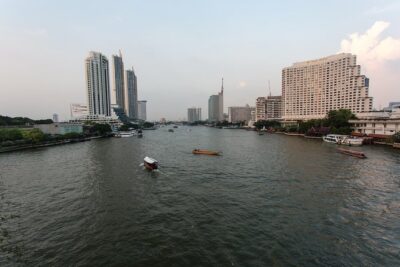
Bangkok by Night: Temples, Markets and Food Tuk-Tuk Tour
Read our review →
Grand Palace, Wat Pho, and Wat Arun Guided Tour
Read our review →
Tiger Cave Temple, Emerald Pool and Hot Springs Tour
Read our review →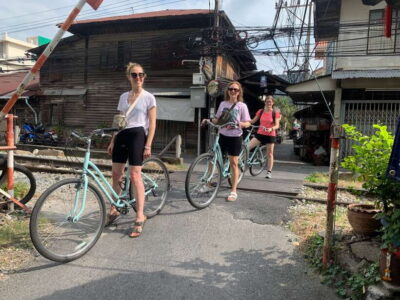
Chiang Rai White Temple and Blue Temple Day Tour
Read our review →Browse the lists this tour appears in